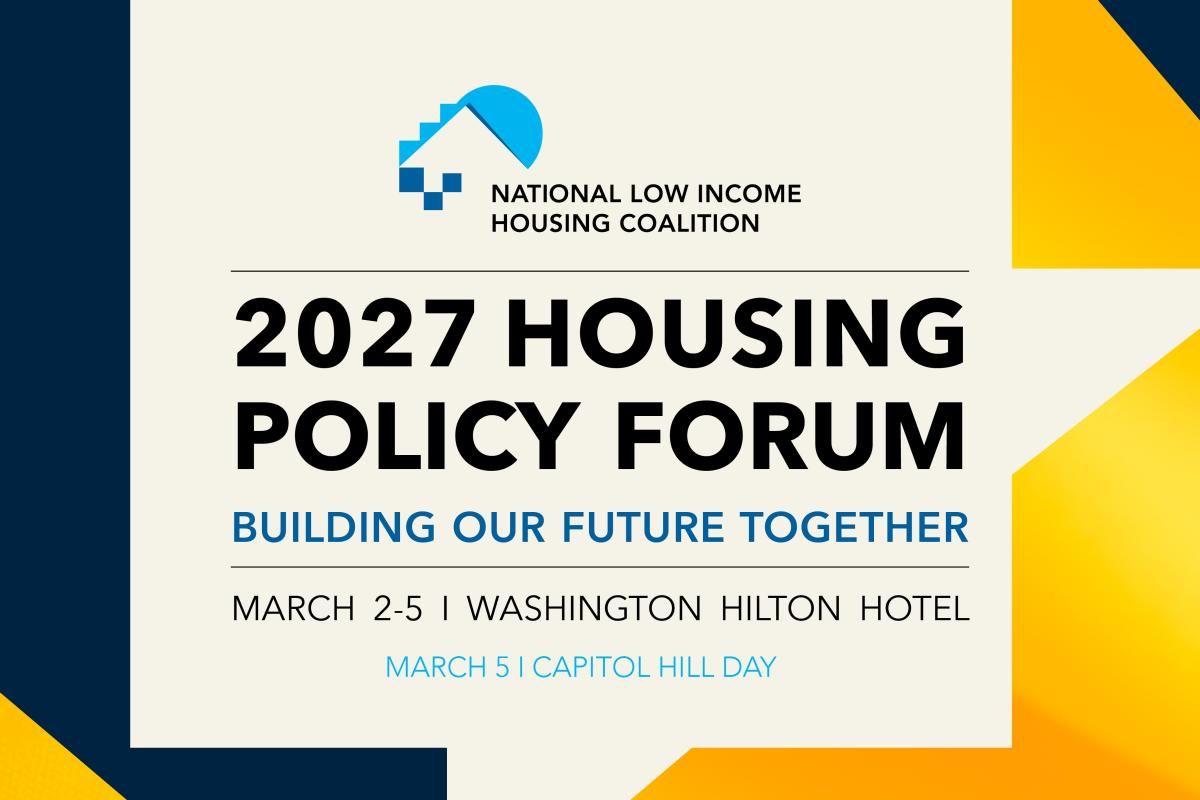
2027 Housing Policy Forum
Early Bird Registration is Now Open!
March 2-5, 2027 | Capitol Hill Day: March 5
NLIHC’s 2027 Housing Policy Forum will convene community leaders, policy experts, researchers, tenant advocates, affordable housing practitioners, and members of Congress for thought and action partnership on ending the housing crisis impacting the lowest-income and most marginalized renters in America.
What You Need to Know
- Early Bird Registration: October 1, 2026 to December 1, 2026
- General Sales: December 2, 2026 to February 2, 2027
Early Bird Registration Ticket Prices
- Member: $650 (increases to $800 on December 2)
- Non-Member: $750 (increases to $900 on December 2)
- Low-Income: $125 (increases to $150 on December 2)
For questions about membership, please contact Lindsay Duvall, NLIHC Manager, Member Engagement, at [email protected]
Featuring:
-
Writer, Art and Cultural Historian
-
Award-winning Author and Journalist
Pre-Forum Schedule
*Pre-Forum sessions are invitation-only for NLIHC State & Tribal Partners and Tenant Leader Members
Pre-Forum: Tuesday, March 2, 2:00 pm to Wednesday, March 3, 1:00 pm
Tuesday, March 2
State & Tribal Partners Convening*
Tenant Leader Session*
State & Tribal Partners/Tenant Leaders Opening Dinner*
Wednesday, March 3
State & Tribal Partners Convening*
State & Tribal Partners & Tenant Leaders Lunch*
Forum Schedule
Forum: Wednesday, March 3, 1:00 pm to Friday, March 5, 4:00 pm
Wednesday, March 3
Opening Plenary Session
Keynote Speaker
Sarah Lewis, writer, art and cultural historian, will share her perspective on the foundational role of art and culture for equity and justice in America. Following her remarks, she will join NLIHC President and CEO Renee M. Willis for a conversation on the idea of failure and the pursuit of success during trying times. Watch Sarah’s TED Talk, “Embrace the near win."
____________________________________________
Breakout 1 – Turning Housing Research into Narrative Change
Housing research helps define the scale and urgency of the housing crisis, but we all know that statistics alone do not always help the public understand the experiences behind the numbers. This forum session will explore how art, storytelling, and creative practice can make housing data more accessible, meaningful, and a useful tool for advocacy. In this session, attendees will see how research and data can be translated into creative expression through one of the various activities such as data-to-poetry, a live artistic interpretation, or a short reading. This session will be an interactive process that connects the creative process to narrative change and considers how these approaches can help individuals understand housing challenges, engage with lived experience, and imagine policy solutions. Participants will leave with practical ideas for bringing creative methods into their own communications, research, and advocacy work.
Breakout 2 – Housing Justice is Disability Justice: Collaborating Across Sectors to Fight Criminalization and Institutionalization
Recent federal policies from the Trump administration are pushing states and localities to clear homeless encampments, criminalize people experiencing homelessness, and forcing people with mental health and other chronic conditions into institutional settings. For example, in 2025, the Trump administration released Executive Order (EO) "Ending Crime and Disorder on America’s Streets.” This EO permits the Attorney General and Secretary of Health and Human Services, with assistance from state and local governments, to criminalize our unhoused neighbors. Similarly, in 2026, the Department of Justice announced its deviation from longstanding Olmstead guidance issued in 2011, allowing institutionalization of people with physical and mental disabilities rather than integrated and community-based settings. These developments intersect to limit people’s options for real, proven solutions.
This session examines the intersection of housing and homelessness, disability, and drug justice by bringing in partners from these spaces to discuss how they're collaboratively building a united movement to combat criminalization and institutionalization at the local, state, and national levels.
Breakout 3 – "Nothing About Us, Without Us - Building Effective Organizing & Advocacy Campaigns"
This interactive session, in collaboration with state and local partners, will use real life examples to walk attendees through how to move from identifying a community-wide problem, to finding a best practice solution, and building out a winning campaign for local or statewide policy change. We will explore how to do this while ensuring that directly impacted people remain at the center - in narrative, decision-making, and advocacy and organizing strategies. We need good policy, research, and people power to win what our communities need to thrive.
This session offers participants concrete tools and processes for the advancement of their local and statewide housing justice campaigns and connects the dots on how to keep momentum up after a win to advance bolder solutions in the future.
Breakout 4 – Power is Taken, Not Given: How to Plan and Execute Effective Actions
Organizing is not just about building power but using it. This session will explore how to plan and execute effective actions (rallies, hill days, town halls, etc.) to leverage power to influence key decisionmakers. We will also challenge potential preconceived notions about relationships with elected officials in the context of the organizing principle: “Power respects power.” Participants can expect to walk away with:
- The ability to define what an action is in an organizing context.
- The ability to distinguish between effective and ineffective actions.
- Tangible tools to employ when planning prospective actions at the local, state, and federal level.
____________________________________________
Opening Reception
Thursday, March 4
Nominations for the 2027 Organizing Awards are Now Open!
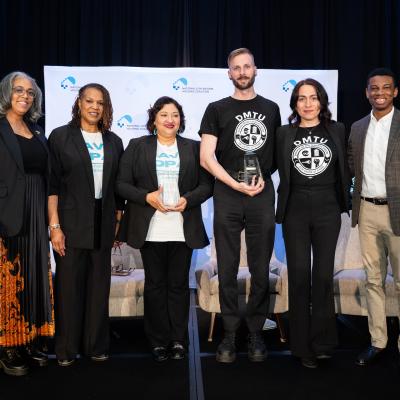
These awards recognize two NLIHC-member organizations’ outstanding achievements in statewide, regional, citywide, neighborhood, or resident organizing over 2026. Special consideration will be given to nominations that incorporate tenant- or resident-centered organizing and leadership and that prioritize racial equity. Winners of this award will be honored on March 4 at Forum.
Nominations are due by 11:59 pm ET on Wednesday, December 16, 2026.
____________________________________________
Plenary Session
____________________________________________
Breakout 5 – Beyond the Usual Suspects: Building Unlikely Partnerships for Housing Justice and Civic Power
Advancing housing justice and strengthening civic engagement require reaching beyond the organizations and networks we already know. Yet organizations can miss opportunities to build meaningful partnerships with institutions, businesses, cultural leaders, technology companies, and community networks that may share their goals but approach their work from different perspectives.
This interactive session will explore how housing advocates and civic engagement practitioners can identify, secure, and sustain nontraditional partnerships that expand their reach, strengthen community relationships, and advance shared goals. Through real-world examples and practical strategies, speakers will unpack how partnerships begin, how organizations establish mutual value and build trust, what challenges they encounter, and how they translate collaboration into meaningful impact.
With 2027 offering an important opportunity to build relationships ahead of the 2028 election cycle, the session will emphasize partnership-building as a long-term strategy rather than a transactional activity reserved for major campaigns. Attendees will leave with a framework for identifying prospective partners, communicating a compelling shared value proposition, and taking concrete steps toward building relationships that advance housing justice and civic participation.
Breakout 6 – Healthy Housing for Healthy Futures: Advancing Housing and Health Equity Through Partnerships
Affordable housing and health care are fundamental aspects of healthy lives and equitable communities. Despite their importance, both housing and health care programs face significant threats to funding and eligibility for people with the lowest incomes. At a time when people are actively losing their health care access and housing costs remain out of reach for many households, it is more important than ever for housing and health advocates to work together to ensure both basic needs are met. This interactive session will feature a panel of health, housing, and legal experts followed by regional group discussions focused on how housing and health systems interact, recent policy changes that impact both sectors and require collaboration, and practical recommendations to build and sustain partnerships.
Breakout 7 – The ROAD Ahead: The 21st Century ROAD to Housing Act and What Comes Next
In 2026, Congress passed the first bipartisan housing bill in decades. This bill included some big wins, but there is more work to be done, especially when it comes to extremely low-income renters. This session will bring together housing experts to talk about how ROAD is being implemented, with a special focus on the Reforming Disaster Recovery Act, and about ideas for future housing legislation.
Breakout 8 – A Housing Policy Blueprint for 2029
What would it take to transform federal housing policy to ensure that everyone has a safe, affordable place to call home? Housing 2029 Blueprint is an initiative to develop an implementation-ready federal housing justice plan for a future administration and Congress, with detailed agency-level recommendations, legislative priorities, staffing plans, and a strategy for implementation beginning on Day One. This interactive session will introduce the Blueprint and invite participants to help shape the policy priorities, partnerships, and implementation strategies needed to turn its vision into reality. Bringing together experts in fair housing, civil rights, tenant organizing, and housing justice, the session will explore how to expand permanently affordable housing, strengthen tenant power, end discrimination, regulate predatory investment, and ensure that federal agencies have the capacity to deliver. Through small-group breakouts, participants will identify opportunities for collaboration between policy development and grassroots organizing and consider how the housing justice movement can prepare to make the most of the 2029 policy window.
Breakout 9 – Actually Accessible Housing
Accessible housing goes far beyond meeting the minimum requirements of the Americans with Disabilities Act (ADA) and other federal requirements. For people with disabilities, a home is only truly accessible when it is affordable on their income, supports independent living and fully integrated community participation, and offers timely accommodations and modifications as needed. This panel will bring together perspectives from disability-forward housing developers, grassroots disability rights organizing, and mission-driven affordable housing providers to explore what it takes to make housing actually accessible. Panelists will examine how affordability, design features, property operations, resident services, tenant application and selection processes, and neighborhood connectivity shape the experience of living in an accessible home. Participants will leave with practical strategies for moving beyond minimum compliance toward housing systems that center disability leadership, inclusion, and the ability of people with disabilities to live where and how they choose.
____________________________________________
Closing Plenary Session
Keynote Speaker
Ta-Nehisi Coates, award-winning author and journalist, will deliver powerful excerpts from one of his best-selling books. NLIHC President and CEO Renee M. Willis will then engage in a conversation with Coates on the examination of discriminatory housing policies and the challenges housing advocates face in confronting the history of systemic barriers to affordable housing. This discussion will conclude with a Q&A with the audience.
____________________________________________
NEW! Hill Day Planning Event
Friday, March 5 – 8:00 am to 4:00 pm (Capitol Hill Day)
Capitol Hill Day provides advocates with the opportunity to meet with their members of Congress to oppose funding cuts to affordable housing and homelessness programs, expand resources for vital initiatives, advance anti-racist policies, and support legislation that improves the lives of millions of low-income people.
The day will begin with an optional kickoff event at Lutheran Church of the Reformation (212 East Capitol St NE, Washington, DC 20003).
NLIHC will provide shuttle service to and from the Lutheran Church for Hill Day. These services can accommodate wheelchairs. The last shuttle will leave the Hilton at 4:00 pm.
For questions about Capitol Hill Day, please contact [email protected].
Hotel and Travel Scholarships
Hotel
Washington Hilton, 1919 Connecticut Avenue, NW, Washington, DC 20009
Deadline to reserve a room (while supplies last): Friday, January 29, 2027
Room Rate:
- $316 + 15.95% tax Standard room night
- $295 + 15.95% tax GSA rate for qualifying guest; show your government idea upon check-in, limited number of rooms and while supplies last.
NOTE: Hotel requires a credit card for incidental’s that will be fully refunded if not used.
Travel Scholarships
NLIHC will offer 20 hotel and travel scholarships to support low-income individual members' participation in the 2027 Housing Policy Forum. Scholarship recipients must register and pay the $125 low-income rate to attend the 2027 Forum and will be reimbursed for their travel expenses. Scholarship applications are now open! Apply today before the December 21, 2026 deadline.
Travel and Accommodation Guidelines
- Travel Stipend: Each recipient is eligible for up to $800 in travel reimbursement, subject to the guidelines outlined below.
- Reimbursement Deadline: All reimbursement forms, receipts, and supporting documentation must be submitted within 15 business days after the final day of the Forum.
- Hotel Accommodations: Each recipient will receive one (1) standard room at the Washington Hilton.
- Travel Booking Assistance: If a recipient is unable to book their travel in advance, we will arrange their travel on their behalf.
For membership questions, please contact [email protected].
For questions, contact:
Adelle Chenier
Senior Director of Events
[email protected]
Lisa Marlow
Senior Director of Communications
[email protected]
Check Out Highlights from 2026 Housing Policy Forum!