By Renee M. Willis, NLIHC President and CEO
As we approach another consequential election season, I keep coming back to a fundamental truth: our fight for housing justice is inseparable from our fight for a healthy democracy.
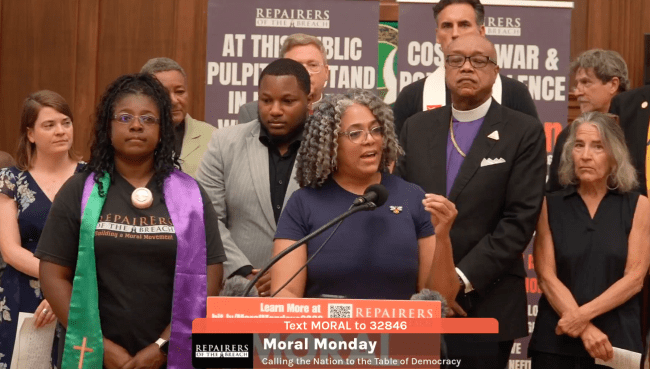
Earlier this month, on August 3, NLIHC stood alongside the Repairers of the Breach and other partners for Moral Monday. We showed up because the struggle for affordable homes does not exist apart from the larger struggle for dignity, opportunity, and a government that is responsive to the people it serves. And we showed up because housing advocates have a role to play in protecting and strengthening our democracy.
For millions of people with the lowest incomes, the decisions made through our democracy are deeply personal. They determine whether a family can afford rent and still buy groceries. Whether someone experiencing homelessness has a path to a permanent home. Whether a senior can remain in the community they have called home for decades. Whether a child grows up with the stability that comes from knowing where they will sleep each night. These are policy choices. And elections help determine who gets to make them. At NLIHC, we see the consequences of those choices every day.
Our latest Out of Reach report once again makes clear just how far wages and rents have grown apart for millions of workers. Across the country, people working full time in essential jobs are still unable to afford a modest home at fair market rent. And for renters with the lowest incomes, the shortage of affordable and available homes remains staggering. Those numbers tell us something important. The housing crisis we face is not inevitable. It reflects decisions about what we prioritize, what we fund, whose experiences shape public policy, and whose voices are heard. That is why voting matters.
But democracy requires more than showing up on Election Day. It requires people to understand the power they hold and to use that power—to organize, advocate, tell their stories, hold elected officials accountable, and vote. That is the idea behind NLIHC’s Our Homes, Our Votes campaign.
Through the campaign, we work with housing organizations, tenant leaders, advocates, and partners across the country to strengthen nonpartisan voter and candidate engagement among low-income renters. People most directly affected by our nation’s housing crisis should have a powerful voice in determining its solutions. Too often, however, people with the lowest incomes face the greatest barriers to participating in our democracy.
Housing instability itself can make participation more difficult. When someone is worried about an eviction, moving from place to place, working multiple jobs, or trying to keep a family housed, civic participation can understandably fall further down the list of immediate concerns. That makes our work even more important.
Our role as a housing movement cannot end with helping people understand housing policy. We must also help build the power necessary to change it. That is why moments like Moral Monday matter. Our participation on August 3 was about recognizing that we are part of something larger than any single organization or issue. Affordable housing is connected to wages. It is connected to health. It is connected to racial and economic justice. It is connected to whether people can remain in their communities. And it is connected to whether people believe they have a meaningful voice in the decisions that shape their lives.
When housing advocates show up for democracy, we strengthen the movement for housing justice. And when renters with low incomes vote, organize, and make their voices heard, our democracy becomes more representative of the people it is supposed to serve.
Over the coming months, I hope every member and partner of NLIHC will consider what more we can do—not in a partisan way, but in a purposeful one—to help people participate. That might mean registering eligible voters. It might mean helping residents understand when and where they can vote. It might mean hosting nonpartisan candidate forums, talking with candidates about housing, sharing voter information, or making sure the people we serve know that their experiences and their voices matter. And, importantly, it means continuing to organize after the ballots are counted.
Because our goal is bigger than any single election. We are working toward a country where everyone has a safe, accessible, and affordable home—and where the people most affected by housing policy have real power in shaping it.