Much of what is known about renters in the U.S. comes from national datasets like the American Housing Survey, Census Household Pulse Survey, and American Community Survey. While these resources provide considerable detail on topics like rental housing quality, rent costs, and renter demographics, they include only limited information on renters’ experiences and opinions about housing.
To fill these and other research gaps, NLIHC launched the National Renter Survey, a nationally representative survey focused on renters’ under-explored experiences and opinions related to housing.
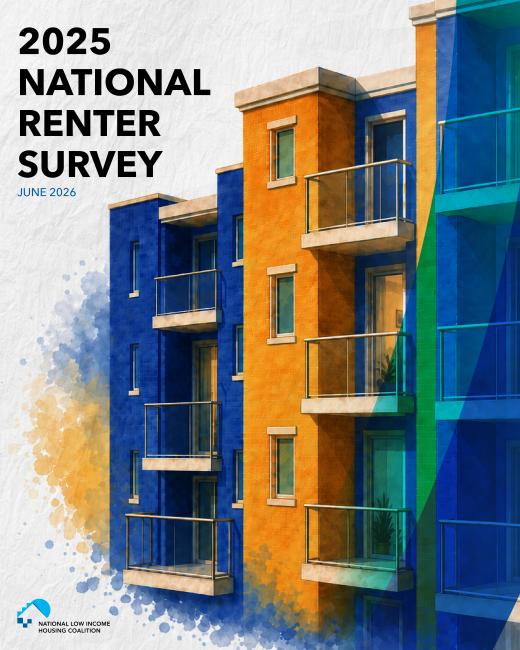
Now Available! 2025 National Renter Survey
Released in June 2026, the 2025 survey and report explored renters’ moving decisions, experiences with housing costs and assistance, accessibility needs, and habitability concerns in their homes.
Key Findings
Notable Key Findings from the 2025 National Renter Survey
Experiences with Moving
Unaffordable rents were both a motivator and a barrier to moving. Among renters who considered or took steps toward moving in the last two years, but did not ultimately move, 38.4% cited being unable to afford their current rent as a reason why they wanted to move. Seventy percent of these almost-movers said they did not move because they could not find a home with affordable rent.
Housing Costs & Housing Assistance
Renters who identify as Black or African American, who have or live with someone who has a disability or chronic health condition, or who live in lower-income households reported struggling to pay rent more frequently over the last two years than other demographic groups. Over half of renters (54.8%) who struggled to pay rent reported that they could not pay some or all of the rent on time, were charged a fee for late rent, or both at some point in the last two years; one in ten of these renters said this difficulty resulted in some form of eviction. Among the 5.7 million renters who said they or someone in their household applied for housing assistance in the last two years but did not receive it, 37.8% were denied, 36.8% were waitlisted, and 17.3% never heard back about their application. A quarter of renters whose applications were denied were never told the reason for the denial.
Accessibility Needs in Rental Housing
About 10.2 million adult renters in the U.S. either need or live with someone who needs accessibility features to live safely and independently. Nearly all of these renters (87.9%) are older adults aged 62 and above, live with a disability or chronic health condition, or live with at least one person with these characteristics. Most renters’ household accessibility needs are going unmet; at least 65.0% of renters who need mobility features and 77.1% of renters who need sensory features do not have them in their current home. Nearly half of renters with household accessibility needs (43.7%) say landlords are typically unwilling to add accessibility features to a rental home or building when asked to do so.
Safe & Habitable Rental Housing
About four of five renters (79.9%) agreed that rental homes should be required to pass periodic inspections conducted by an authorized agency to ensure those homes are safe to live in, and about a third of renters believed there are no circumstances under which a renter should be permitted to decline a required housing inspection. A greater share of renters currently receiving housing assistance agreed with these statements relative to other renters.
Read the full 2025 National Renter Survey here.
About the Survey
The 2025 National Renter Survey was designed to ask questions and gather data not frequently captured by national surveys. It includes questions on experiences applying for and receiving housing assistance, renter-landlord interactions related to habitability, experiences with moving and displacement, and the unique needs and experiences of renter households with disabilities or chronic health issues.
NLIHC received support and feedback from a 20-member advisory committee, tenant leaders, housing advocates, and researchers, as well as NLIHC board members, State & Tribal Partners, and Tenant Collective alumni. NLIHC developed the survey questionnaire and partnered with research firm ICF to test the survey with a diverse group of renters, determine a sampling and weighting strategy, and administer the survey between July and December 2025.
A random sample of households were selected from national datasets of residential addresses and cell phone numbers. These households were invited by mail, phone call, or text message to participate in the survey, which could be completed in about 15 minutes online or over the phone, in English or Spanish. Participants who completed the survey were offered an Amazon digital gift card for their time and contributions. Individuals needed to be current renters (with or without paying rent) at least 18 years of age to be eligible to participate in the survey.
A detailed methodology of the 2025 National Renter Survey is available here.
Why “Renters” Instead of “Tenants”?
While the terms “renters” and “tenant” are often used interchangeably, the latter refers to someone who has a legal right to rent a property, often demonstrated by a lease agreement or otherwise provided by law. The National Renter Survey and this report use the term “renter” to capture the broader experiences of individuals impacted by rental housing policy, including those who never signed a lease or may have lost their legal right to occupy a rental home. Individuals generally qualified as renters for this survey if they lived in a home that they did not own, regardless of whether they paid rent. This includes individuals living in doubled-up households. Individuals who lived in group housing, such as nursing homes or student dormitories, and those experiencing homelessness were not included in the survey. This was a deliberate decision by NLIHC to respect the distinct experiences and needs of those populations that would not be adequately captured by the survey.